
Everyone is talking about AI — but what if the real revolution is quietly happening in a lab right now? 📡
While ChatGPT grabs the headlines, Quantum Computing has been building up to something massive.
Think of AI as the brain that processes existing data. Quantum Computing is the engine that can simulate reality itself — solving problems that would take a regular computer millions of years, in just minutes.
In February 2026 alone, three landmark breakthroughs dropped at once. Experts are now saying the “Quantum Winter is officially over.”
This guide breaks it all down — from plain-English basics to real investment implications. And make sure you scroll to the end — there’s an action checklist you won’t want to miss!
Beyond AI: Why 2026 Is the Year of Quantum Computing
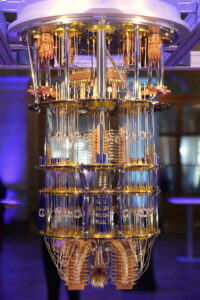
Remember when everyone said AI was “just around the corner” — and then suddenly ChatGPT was everywhere? Quantum Computing is having that same moment. Except this time, the implications are even bigger.
Since the 1990s, scientists have been promising that quantum computers would revolutionize everything. But year after year, the hardware stayed fragile, the errors stayed high, and the commercial applications stayed frustratingly out of reach. The tech world started calling this the “Quantum Winter” — a long, cold stretch where the hype far outpaced the reality.
But in February 2026, the ice finally broke. In a single month, we saw:
- A historic Majorana qubit breakthrough that solves quantum computing’s oldest hardware problem
- IonQ’s $1.8 billion acquisition of a semiconductor foundry — signaling quantum hardware is ready for mass production
- Google proving that its Willow chip reduces errors as qubits scale up — flipping a decades-old paradox on its head
Keep reading — each section below digs into the details, with real data and real-world implications you can actually use. ⬇️
Wait — What Exactly IS Quantum Computing? (Plain English)
Before we get into breakthroughs and billion-dollar deals, let’s make sure we’re all on the same page. Because honestly? Most articles about quantum computing make it sound way more complicated than it needs to be.
Regular computers: The light switch
A normal computer stores everything as bits — tiny switches that are either OFF (0) or ON (1). Every email you send, every photo you take, every Netflix episode you binge — it’s all just billions of 0s and 1s flipping on and off incredibly fast.
Quantum computers: The spinning coin
A quantum computer uses qubits instead of bits. Here’s the wild part: a qubit can be 0 AND 1 at the same time. Imagine flipping a coin — while it’s spinning in the air, it’s technically both heads and tails simultaneously. That’s called superposition, and it lets a quantum computer explore millions of possible answers all at once, rather than checking them one by one.
There are two other key concepts that make quantum computers so powerful:
- Entanglement: Two qubits can be “linked” so that changing one instantly affects the other — no matter how far apart they are. Einstein famously called this “spooky action at a distance.” (Even Einstein was weirded out. You’re in good company.) This allows quantum computers to process information in a deeply interconnected way classical computers simply cannot.
- Interference: Quantum computers use wave-like behavior to cancel out wrong answers and amplify the right ones — like noise-canceling headphones, but for bad calculations. This is how they zero in on the correct solution so efficiently.
Qubits are incredibly fragile. The slightest vibration, temperature change, or electromagnetic interference destroys the quantum state — a problem called “decoherence.” Right now, most quantum computers spend over 99% of their computing power just correcting errors caused by this fragility. That’s the wall that’s been blocking commercial quantum computing for 30 years. And in February 2026, researchers may have finally found the door. 👇
The “Dream Qubit”: The Majorana Breakthrough Explained
On February 16, 2026, a research team from CSIC (Spain) and Delft University of Technology (Netherlands) published a result that the quantum physics community had been chasing for decades.
Who was Majorana, and why does it matter?
In 1937, Italian physicist Ettore Majorana predicted the existence of a strange particle that is its own antiparticle. Decades later, scientists realized that qubits built from these so-called “Majorana particles” would be naturally resistant to errors — not because of clever error-correction software bolted on top, but because of their fundamental physics.
Think of it this way: regular qubits are like writing on a whiteboard with a dry-erase marker — any breeze or bump can smudge it. Majorana qubits are like carving into stone. The information is encoded in a way that’s almost immune to environmental disturbance.
The catch? Reading a Majorana qubit’s state was thought to be nearly impossible without destroying it in the process. Like trying to look inside a soap bubble without popping it.
🔬 The February 2026 Breakthrough: Quantum Capacitance
The CSIC/Delft team solved this using a technique called “Quantum Capacitance” — essentially a way to “sense” the qubit’s state without directly touching it. Like using sonar to map the ocean floor without sending a diver down.
This opens the door to Topological Quantum Computing — a class of quantum computers that are inherently stable, require far less error correction overhead, and could eventually run at temperatures much closer to room temperature. No more football-field-sized cooling systems required.
To put the scale of this in perspective: if current quantum computers are propeller planes — functional but limited — topological quantum computers are jet engines. The physics is just fundamentally better.
Curious to dive deeper into the research? The latest quantum physics papers are freely available on arXiv’s quantum physics archive. Fair warning — it gets technical fast. 😄
IonQ’s Bold Move: $1.8 Billion Vertical Integration Play
While the scientists are busy rewriting physics, IonQ is busy rewriting its balance sheet. In early 2026, the quantum computing company acquired semiconductor foundry SkyWater Technology for $1.8 billion — one of the biggest bets ever placed in the quantum hardware space.
Why vertical integration is a game-changer
Think about why Apple is so hard to compete with. They design their own chips (the A-series and M-series), build their own operating system, and control the entire user experience end-to-end. That tight control is why an iPhone just works in a way most Android phones don’t quite match.
IonQ is pulling the same move. By owning SkyWater, they now control the full stack:
- Chip design → Semiconductor manufacturing → Quantum hardware → Software. No more dependency on outside suppliers who may not understand quantum requirements.
- Already delivering results: IonQ has achieved a 99.99% fidelity rate for 2-qubit gates — the gold standard measure of quantum accuracy. That’s not a lab demo number; that’s a production number.
- 256-qubit system by end of 2026: IonQ’s roadmap calls for a 256-qubit system demonstration later this year — a significant leap that would put them ahead of most competitors in raw qubit count.
- Government contract advantage: SkyWater is a U.S. Department of Defense-approved foundry. That opens doors to classified government and military quantum computing projects that most competitors simply can’t access.
Google Willow vs. IBM Qiskit — Two Giants, Two Very Different Bets
The race for quantum leadership isn’t just a two-horse race anymore. But the contrast between Google and IBM’s strategies is fascinating — they’re after the same finish line but taking completely opposite roads to get there.
| 🔵 Google (Willow Chip) | 🔴 IBM (Qiskit Ecosystem) | |
|---|---|---|
| Core Strategy | Hardware supremacy | Software ecosystem dominance |
| Feb 2026 Achievement | Proved error rates fall as qubits scale | Major investment in quantum software startups |
| Best Analogy | Building the world’s fastest engine | Paving all the roads and installing every GPS |
| Long-Term Goal | First error-free commercial quantum computer | Become the standard platform for all quantum code |
Google’s Willow chip: Flipping the paradox
For years, quantum computing had an embarrassing paradox: adding more qubits added more errors. Scaling up made things worse, not better — like hiring more employees but watching productivity collapse because of all the miscommunication.
Google’s Willow chip broke that pattern. In 2025, Google demonstrated experimentally that as they added more qubits to Willow, the error rate actually decreased. That’s not just an improvement — it’s a complete reversal of the fundamental challenge. It means large-scale, practical quantum computers are now a matter of engineering, not physics.
IBM’s Qiskit: The developer ecosystem play
IBM isn’t trying to win the hardware race. IBM is trying to win the platform race. Their open-source Qiskit framework is now used by over 500,000 developers worldwide — and IBM is betting that whoever writes the code standard wins the war.
The strategy mirrors how Android became dominant in smartphones — not by making the best hardware, but by building the operating system that everyone else builds on. IBM’s message to the world is clear: “Whatever quantum hardware you use, write your code in Qiskit.”
If you’re a developer curious about getting hands-on, IBM offers free quantum computing access and courses via IBM Quantum Learning. Check out the action checklist at the end of this post for more resources! ⬇️
How Will This Actually Affect Your Life?
“Okay, this all sounds impressive — but what does it mean for me?” Fair question. Let’s make it concrete.
💊 Medicine: From 15 years to 1 year
Developing a single new drug takes an average of 15 years and costs over $2 billion. A huge chunk of that time is spent running molecular simulations — trying to figure out how a candidate drug will interact with the human body at the atomic level. Quantum computers can simulate molecular behavior in ways that are simply impossible on classical hardware. Early projections suggest quantum-assisted drug discovery could compress that timeline to 1–2 years. We’re talking faster treatments for Alzheimer’s, cancer, antibiotic-resistant infections — the diseases that medicine has been stuck on for decades.
🔐 Cybersecurity: The threat you need to know about NOW
This one isn’t all good news. Every time you do online banking, send an encrypted email, or use a cryptocurrency wallet, your security depends on mathematical problems that are too hard for today’s computers to solve. A sufficiently powerful quantum computer could crack most of today’s encryption in minutes.
Worse: bad actors are already running a “harvest now, decrypt later” strategy — collecting encrypted data today and planning to unlock it once quantum computers are powerful enough. This is why the U.S. National Institute of Standards and Technology (NIST) finalized Post-Quantum Cryptography standards in 2024. Businesses that haven’t started migrating should start now.
⚡ Energy & Climate: Better batteries, faster
Designing next-generation batteries for electric vehicles, more efficient solar panels, and viable hydrogen fuel cells all require understanding chemistry at the quantum level. Classical computers can barely simulate a caffeine molecule accurately — quantum computers can handle entire protein chains and material structures. This could accelerate the clean energy transition by years, not months.
📈 Finance: Optimization at a scale never before possible
“Find the optimal portfolio out of 100,000 stocks, accounting for 10,000 variables, in real time.” Today’s supercomputers wave the white flag at problems like this. Quantum computers don’t have to. Goldman Sachs and JPMorgan already have active quantum computing research teams — not because it’s trendy, but because whoever cracks quantum finance first wins.
Action Checklist: How to Prepare for the Quantum Leap
The transition to a quantum-first world will be faster than most people expect. Here’s what you can do right now depending on who you are. ✅
👨💻 Developers & Tech Professionals
- Start with Qiskit: IBM’s IBM Quantum Learning platform offers free courses from absolute beginner to advanced. You can run code on a real quantum computer via the cloud — no hardware required.
- Learn Post-Quantum Cryptography (PQC): Get familiar with NIST’s approved PQC algorithms: CRYSTALS-Kyber (encryption) and CRYSTALS-Dilithium (digital signatures). These will become the new internet security standard.
- Try cloud quantum access: AWS Braket, IBM Quantum, and Google Cirq all offer real quantum computer access today. Experiment now so you’re not scrambling later.
💼 Investors & Business Strategists
- Watch the pure-play quantum stocks: IonQ (IONQ), Rigetti (RGTI), and D-Wave (QBTS) are the bellwethers. Follow their earnings calls and roadmap updates closely.
- Track Big Tech quantum divisions: Watch the quantum sections of Alphabet, IBM, and Microsoft (Azure Quantum) quarterly reports for commercial timeline signals.
- Consider ETF exposure: The Defiance Quantum ETF (QTUM) tracks a blended quantum + AI index — a lower-risk way to gain exposure to the sector.
🏢 Business & Security Leaders
- Audit your cryptographic assets: Make a list of every system using RSA or ECC-based encryption. These are your quantum vulnerabilities.
- Take “harvest now, decrypt later” seriously: Sensitive data transmitted today could be decrypted by adversaries within 5–10 years. Classified, medical, and financial data are the highest priority.
- Build a PQC migration roadmap: Aim to transition core systems to quantum-resistant encryption by 2027. It sounds far away. It isn’t.
🚀 Final Thought
Quantum Computing isn’t “someday” technology anymore. In 2026, the tipping point is happening in real time — in labs, in boardrooms, and in government agencies around the world. AI changed the world once. Quantum Computing is going to change the world that AI built.
The best time to start paying attention was five years ago. The second best time is right now.