Something quietly shifted in 2025. Millions of users who built their daily routines around ChatGPT started asking a question they never expected to ask: “Is it time to leave?” The hashtag #QuitGPT started appearing on X (formerly Twitter), Reddit threads filled with frustration, and a new generation of AI competitors leaned in with open arms.
But what’s really going on here? Is this just tech drama — or a genuine reckoning with where AI power and politics intersect? Let’s break it all down. And stick around, because we’ve got a Strategic AI Checklist at the end that will help you decide exactly which tool deserves your subscription money.
1. The Sam Altman Controversy: Money, Politics, and Power
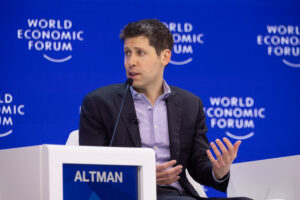
Photo: Benedikt von Loebell / World Economic Forum / CC BY-NC-SA 4.0
To understand the #QuitGPT movement, you have to understand the man at the center of it: Sam Altman, CEO of OpenAI, and his husband Oliver Mulherin, an Australian software engineer. Together, they’ve signed The Giving Pledge — a commitment to donate the majority of their wealth to charity. Noble stuff. But it’s Altman’s political spending that has people raising eyebrows.
Here’s the verified track record, sourced directly from Federal Election Commission (FEC) records via OpenSecrets:
- Donated over $1 million to Democratic candidates and PACs since 2013 — including Barack Obama, Joe Biden, Kamala Harris, Elizabeth Warren, and Andrew Yang.
- Gave $200,000 to the Biden Victory Fund in 2023 ahead of the 2024 election. Source: ABC News, Jan 2025
- Then, in December 2024, donated $1 million to Donald Trump’s inauguration fund — drawing immediate criticism from Democratic senators Elizabeth Warren and Michael Bennet. Source: Axios, Jan 2025
- Altman’s response on X? “Funny, they never sent me one of these for contributing to Democrats.” (He has a point. It’s also kind of hilarious.)
By July 2025, Altman himself described feeling “politically homeless,” saying he believed in “techno-capitalism” and criticizing the Democratic Party for no longer fostering a culture of innovation. Meanwhile, OpenAI was spending over $1.7 million on federal lobbying in the first half of 2025 alone. Source: Brennan Center for Justice, Oct 2025
Whether you see this as smart strategy or troubling influence-buying depends on your perspective. But either way — it’s not a neutral look for the world’s most powerful AI company.
2. “Woke AI” and the Erosion of User Trust
As OpenAI’s leadership became increasingly entangled in politics, users noticed something changing in ChatGPT’s behavior. The term “Woke AI” became a rallying cry — not just from conservatives, but from writers, coders, business professionals, and everyday users who felt the tool was becoming a digital nanny rather than a raw, useful assistant.
Common complaints include:
- Refusing to write satirical content about certain public figures while freely doing so for others
- Adding unsolicited moral disclaimers to straightforward factual requests
- Giving noticeably different answers to politically sensitive questions depending on which “side” is being discussed
- Over-filtering creative writing in ways that feel inconsistent and unpredictable
Is all of this fair? Not entirely. Some of ChatGPT’s caution reflects genuine safety considerations. But perception matters — and the perception that an AI tool is politically biased is enough to send users looking elsewhere.
3. The 2026 AI Trinity: Claude, Gemini, and the New Order
The good news? Competition has never been stronger. Three distinct AI philosophies have emerged in 2026, and understanding them is the key to choosing the right tool for your life.
🧠 Anthropic Claude — “The Rationalist”
Claude (currently Sonnet 4.5/4.6) has become the go-to for users who prioritize objective reasoning and unbiased dialogue. Anthropic’s approach — called Constitutional AI — builds safety rules directly into the model’s values, rather than bolting them on as a filter. The result is a model that feels more like a thoughtful conversation partner and less like a compliance department.
Claude is particularly dominant in coding, legal analysis, and nuanced writing — tasks where precision and fairness matter most.
📚 Google Gemini — “The Librarian”
Gemini’s superpower is memory. With a 2 million+ token context window, it can hold thousands of pages of documentation in its “head” at once — perfect for professionals dealing with complex datasets, research papers, or large codebases. If your workflow involves feeding an AI enormous amounts of information, Gemini is your tool.
⚙️ ChatGPT (OpenAI) — “The Pioneer”
Love it or leave it, ChatGPT defined the modern AI era. Its reasoning model (o1/o3) remains among the best for complex multi-step problem solving. Its ecosystem — plugins, GPTs, API integrations — is unmatched in breadth. For users already deeply embedded in the OpenAI ecosystem, the switching cost is real. But for new users? The competition has caught up fast.
4. Performance Benchmarks: Which AI Reigns Supreme?
Let’s cut through the marketing and look at what actually matters in 2026. The table below reflects current user experience, published benchmarks, and independent testing:
| Category | ChatGPT (o3) | Gemini 2.0 Pro | Claude Sonnet 4.6 |
|---|---|---|---|
| Perceived Political Neutrality | Mixed (inconsistent) | Moderate | High (consistent) |
| Coding & Development | Excellent | Good | Industry-leading |
| Context Window (Memory) | 128K tokens | 2M+ tokens | 200K tokens |
| Creative Writing Quality | Very Good | Good | Excellent |
| Multi-step Reasoning | Best-in-class (o3) | Very Good | Very Good |
| Ecosystem & Integrations | Widest ecosystem | Strong (Google suite) | Growing fast |
| Price (Pro tier, monthly) | $20 | $19.99 | $20 |
No single tool wins across every category — which is why the smart move is to match your tool to your specific use case. More on that below. 👇
5. Final Verdict + Strategic AI Checklist
The #QuitGPT movement isn’t about tech rage. It’s about something more interesting: the growing awareness that the AI tools we use every day are shaped by the values — and the politics — of the people who build them. That’s not inherently bad. But it’s worth knowing.
Here’s the plain-English verdict:
- Choose Claude if you value consistent, unbiased dialogue and do a lot of writing, coding, or analysis where intellectual honesty matters.
- Choose Gemini if you work with massive documents, complex research, or need deep integration with Google Workspace.
- Stick with ChatGPT if you’re already deep in its ecosystem, rely on its plugin library, or need the absolute best multi-step reasoning (o3 model).
- Use all three — seriously. Most power users mix tools depending on the task. There’s no rule that says you can only have one AI subscription.
✅ Strategic AI Checklist: Find Your Best Match
- I write, code, or analyze information daily → Claude Sonnet 4.6
- I work with large documents, PDFs, or research papers → Gemini 2.0 Pro
- I need complex reasoning chains or math → ChatGPT o3
- I want an AI that feels balanced and doesn’t moralize at me → Claude
- I’m already using Google Docs/Sheets/Gmail daily → Gemini
- I rely on a specific GPT plugin or custom workflow → ChatGPT
- I’m building a product or API integration → All three offer APIs — compare pricing on their developer pages
The AI landscape in 2026 is healthier precisely because of movements like #QuitGPT. Competition forces improvement. And right now, users have more genuinely great options than at any point in AI history.
So — are you rethinking your AI subscription?
 KO
KO  EN
EN