
You've probably heard “quantum computing is the future.” But NVIDIA just made that future arrive a lot faster — and most people have no idea what just happened.
1. So… What Just Happened?
On April 14, 2026 — World Quantum Day — NVIDIA dropped something that sent shockwaves through the entire tech world. They released a new open-source AI model called NVIDIA Ising, and within hours, quantum computing stocks went absolutely wild. IonQ shot up over 50% in a single week. D-Wave surged 46%. Rigetti jumped 30%.
But here's the thing — most people saw the stock ticker go up and had no idea why. What is Ising? Why does it matter? And why are serious scientists saying it could move quantum computing's timeline up by a decade?
Grab a coffee. Let's break this down in a way that actually makes sense — even if you've never thought about quantum computing before.
↓ Keep scrolling — the “plain English” explanation below will make everything click ↓
2. Quantum Computing in Plain English
Before we talk about NVIDIA Ising, you need to understand what quantum computing is — and more importantly, why it's been so frustratingly hard to build.
Regular computers (like the one you're reading this on) work with bits — tiny switches that are either 0 or 1. That's it. Everything your computer does — watching YouTube, running spreadsheets, sending emails — comes down to billions of 0s and 1s flipping on and off.
Quantum computers use qubits instead of bits. And qubits can be 0, 1, or both at the same time. This is called superposition, and it's what gives quantum computers their mind-bending potential. While a regular computer tries every possible answer one at a time, a quantum computer can explore many possibilities simultaneously.
Think of it this way: finding a specific person in a crowd of 1,000 people using a regular computer means checking each person one by one. A quantum computer could theoretically check them all at once. That's how powerful we're talking.
Global quantum market in 2025
Projected by 2028
Annual growth rate
IBM's fault-tolerant target
3. The Biggest Problem With Quantum Computers
So if quantum computers are so amazing… why don't we have one in every office? Why hasn't this technology been taken over the world yet?
The answer is one word: errors.
Qubits are incredibly fragile. We're talking outrageously fragile. The slightest vibration, temperature change, or electromagnetic interference can cause a qubit to lose its quantum state — a problem called decoherence. And when qubits lose their state, calculations go haywire.
This creates two massive challenges that engineers have been battling for years:
Problem #1: Calibration
Before running any calculation, quantum processors need to be calibrated — meaning every qubit has to be precisely tuned so it behaves predictably. This used to require teams of specialized physicians working manually for days just to get the system ready to run. Imagine needing two days of setup every time you wanted to open a spreadsheet. Exactly.
Problem #2: Error Correction
Even when everything is set up correctly, errors still happen constantly during calculations. To deal with this, engineers use quantum error correction — a system that uses multiple physical qubits to protect a single “logical” qubit. But this correction has to happen in real time, faster than errors accumulate. Until now, that was brutally difficult to do at scale.
↓ This is where NVIDIA Ising comes in — and it changes everything ↓
4. What Is NVIDIA Ising?
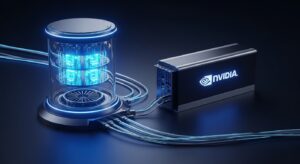
NVIDIA Ising is the world's first open-source AI model family specifically built for quantum computing. Released on April 14, 2026, it targets exactly the two problems we just talked about — calibration and error correction.
The name “Ising” comes from the Ising Model in physics — a mathematical framework used to study how systems with many interacting parts behave. Fitting name for a tool that helps manage thousands of interacting qubits.
NVIDIA released Ising as open-source under the Apache-2.0 license, meaning researchers, universities, and companies worldwide can download and use it for free. You can find it on GitHub and Hugging Face right now. (And yes, Jensen Huang announced it himself.)
5. How Does Is Actually Work?
NVIDIA Ising comes in two parts, each tackling one of the core problems:
Part 1: Ising Calibration
This is a massive 35-billion-parameter vision-language model — think of it like a super-smart AI that can “see” the quantum processor, read all its measurement data, and automatically figure out how to tune every qubit to perfection.
Remember how calibration used to take days of manual work by PhD physicists? Is Calibration compresses that down to hours of automated work. No human intervention needed. The AI handles it all, continuously, in the background.
It's so good that it actually outperforms Gemini 3.1 Pro, ChatGPT's GPT-5.4, and even Claude Opus 4.6 on quantum calibration benchmarks. (Yes, NVIDIA's quantum AI beats the world's best general AI models at this specific job.)
Part 2: Ising Decoding
This handles real-time error correction using a 3D convolutional neural network — a type of AI architecture originally developed for analyzing 3D video and medical imaging, now repurposed to catch and fix quantum errors at lightning speed.
The results are striking:
Faster error correction decoding
More accurate than previous tools
Per round (projected fast model)
Parameters in Ising Calibration
Both models plug into NVIDIA's existing infrastructure — the CUDA-Q software platform and the NVQLink hardware interconnect that physically connects quantum processors (QPUs) with NVIDIA GPUs at ultra-low latency.
6. Why Experts Say It's a 10-Year Leap
Here's the honest truth about quantum computing until now: the technology worked in theory, but the engineering overhead was so enormous that practical, commercially useful quantum computers felt decades away.
The two bottlenecks — calibration and error correction — were the walls. You couldn't scale up a quantum system without solving both, and solving both manually was too slow, too expensive, and too dependent on rare human expertise.
NVIDIA Ising doesn't just improve those processes. It automates them. And automation is what allows scale.
| Challenge | Before Ising | After Ising |
|---|---|---|
| Calibration time | Days of manual work by physicists | Hours of automated AI execution |
| Error correction speed | Struggled to keep pace with errors | 2.5× faster, 3× more accurate |
| Expertise required | Specialized quantum engineers on-site | AI handles it; standard HPC staff can operate |
| Scalability | Very limited — bottleneck at every scale-up | Designed for industrial-grade quantum systems |
KB Securities put it bluntly in an April 2026 report: “The quantum computing industry has entered the commercialization trajectory in 2026, with 2029 as the critical inflection point.” Most analysts were saying 2035 or 2040 just two years ago. That's a real timeline compression — and Ising is a major reason why.
↓ Check the Key Takeaways checklist at the bottom — great for sharing ↓
7. Who's Already Using It?
NVIDIA didn't release Ising in a vacuum. They lined up serious adopters at launch — names that give you a sense of how real this technology already is:
- ▸
Harvard University — Using Ising Calibration for research-grade quantum experiments - ▸
Fermi National Accelerator Laboratory (Fermilab) — Integrating into particle physics research workflows - ▸
Lawrence Berkeley National Laboratory — Deploying via their Advanced Quantum Testbed - ▸
IonQ — One of the largest quantum computing companies; using Ising Calibration directly on their hardware - ▸
UK National Physical Laboratory — Bringing AI-driven calibration into national quantum infrastructure - ▸
IQM Quantum Computers — Using it to make their superconducting processors viable for standard enterprise data centers
This isn't a prototype or a research paper. This is production-level technology, deployed right now at some of the most scientifically respected institutions in the world.
8. What Does This Mean for You?
Okay — so NVIDIA built something amazing for quantum physicists. But what does this actually mean for regular people? For businesses? For society?
🔐 Your Online Security
This is the one that should get your attention. Quantum computers, once powerful enough, could theoretically break the encryption systems that protect your bank accounts, passwords, and private data. Google has already published research showing that quantum computers could crack certain encryption types by 2029. The faster quantum computing advances, the faster governments and companies need to switch to post-quantum encryption. That transition is already underway — but it needs to happen faster.
💊 Drug Discovery & Medicine
Quantum computers can simulate molecules at the atomic level — something regular computers simply can't do efficiently. This means faster drug discovery, better understanding of diseases, and potentially cures for conditions that have stumped researchers for decades. NVIDIA's advances in error correction bring this use case meaningfully closer.
🌍 Climate Modeling
Climate systems are extraordinarily complex. Quantum computers could run climate models at a resolution and accuracy impossible today, helping scientists predict — and prepare for — the effects of climate change with far greater precision.
🧠 The bottom line: Quantum computing isn't just a tech story. It's a story about the future of security, medicine, and science. And NVIDIA just moved that future significantly closer. Whether you're an investor, a business owner, or just a curious person — this is worth paying attention to.
✅ Key Takeaways — Quick Reference
- NVIDIA released Ising on April 14, 2026 — the world's first open-source AI model built specifically for quantum computing
- Ising has two parts: Ising Calibration (automates qubit tuning, cutting days of work to hours) and Ising Decoding (real-time error correction, 2.5× faster and 3× more accurate)
- The biggest obstacle to practical quantum computing has always been errors and calibration — Ising directly attacks both problems with AI
- Major institutions already using Ising: Harvard, Fermilab, Lawrence Berkeley National Lab, IonQ, UK National Physical Lab
- Quantum computing market was $1.9B in 2025 and is on track to exceed $4B by 2028, growing at 30% annually
- The advancement has real-world implications for encryption security, drug discovery, and climate science
- NVIDIA's strategy: open-source the model, but keep the surrounding hardware (NVQLink) and software (CUDA-Q) platform proprietary — the same playbook they used to dominate AI with GPUs
 EN
EN  KO
KO